Lunar Eclipse in Iowa: When and How to See the August 2026 Eclipse
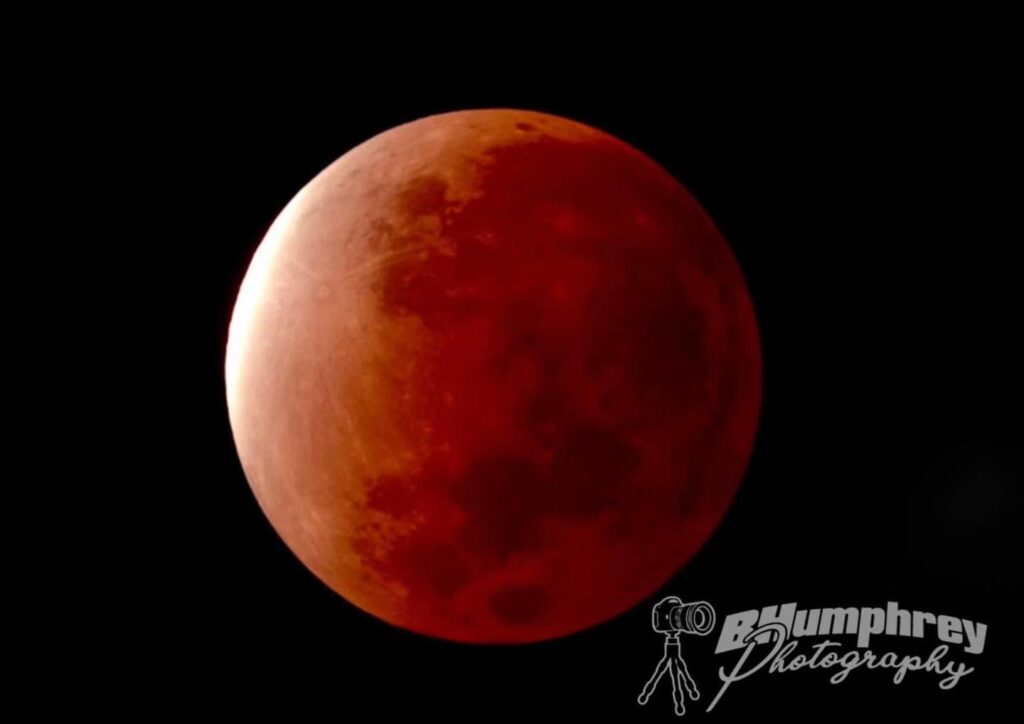
Iowans will have a chance to watch an impressive celestial event unfold Thursday night as a partial lunar eclipse crosses the sky on August 27 into the early morning of August 28, 2026. And despite being classified as a partial lunar eclipse, this one will come remarkably close to totality.
At its peak, more than 96% of the Moon’s disk will be inside Earth’s dark central shadow, according to NASA. That means the Moon could take on a dramatic dark red, copper or orange appearance, with only a thin portion remaining brightly illuminated.
For Iowa, the timing is also favorable. The most impressive part of the eclipse occurs before midnight Thursday, making this an easier astronomical event to watch than many eclipses that peak during the predawn hours.
What Time Is the Lunar Eclipse in Iowa?
The eclipse will occur during the evening of Thursday, August 27, continuing into early Friday, August 28.
Here is the approximate timeline for Iowa in Central Daylight Time (CDT):
- 8:23 p.m. Thursday: Penumbral eclipse begins
- 9:33 p.m.: Partial lunar eclipse begins
- 11:12 p.m.: Maximum eclipse
- 12:51 a.m. Friday: Partial eclipse ends
- 2:01 a.m.: Penumbral eclipse ends
These times are based on calculations for Des Moines and should be nearly identical across Iowa. If you only want to head outside for the best part, plan on watching between roughly 10:30 p.m. and midnight Thursday night. The peak comes at approximately 11:12 p.m. CDT.
What Will the Lunar Eclipse Look Like in Iowa?
Don’t expect the Moon to suddenly disappear. The eclipse develops gradually over several hours as the Moon moves deeper into Earth’s shadow.
The first stage begins around 8:23 p.m., when the Moon enters Earth’s penumbra, or faint outer shadow. This portion of the eclipse can be difficult to notice. The Moon may simply look slightly dimmer than usual.
Things become much more obvious around 9:33 p.m., when the Moon begins entering Earth’s umbra, the much darker central portion of its shadow. At that point, it may look like a dark “bite” is slowly being taken out of the Moon. Over the next hour and a half, that shadow will spread across almost the entire lunar surface.
By the 11:12 p.m. maximum, roughly 96% of the Moon’s disk will be within Earth’s umbra. NASA describes this as a deep partial lunar eclipse, with only a small portion of the Moon remaining outside the darkest part of Earth’s shadow. Because the eclipse comes so close to totality, it could look surprisingly similar to a total lunar eclipse.
Will the Moon Turn Red?
At least part of it likely will. The portion of the Moon deep within Earth’s shadow can develop a rusty red, copper or orange color. This happens because some sunlight still reaches the Moon even while Earth is blocking the Sun.
Sunlight passing through Earth’s atmosphere is filtered and bent toward the lunar surface. Shorter wavelengths of light, including blues and violets, are scattered more easily by Earth’s atmosphere. Longer red and orange wavelengths are more likely to make it through.
That reddish light can then illuminate the eclipsed portion of the Moon. It’s essentially the combined light of sunrises and sunsets around Earth being projected onto the Moon. The exact color can vary from one eclipse to another depending on conditions in Earth’s atmosphere.
Is This a Blood Moon?
Technically, no. The term “Blood Moon” is commonly associated with a total lunar eclipse, when the entire Moon moves inside Earth’s umbra.
Thursday night’s eclipse falls just short of that. NASA calculates that approximately 96.3% of the Moon’s disk will be within the umbra at maximum eclipse.
So while this isn’t technically a total Blood Moon, it may look very similar to one around maximum eclipse. A thin, brightly illuminated portion of the Moon should remain visible next to the much darker reddish portion.
What Causes a Lunar Eclipse?
A lunar eclipse occurs when the Sun, Earth and Moon line up, with Earth positioned between the Sun and the full Moon.
Earth then casts its shadow into space. Normally, the Moon passes above or below Earth’s shadow because its orbit is tilted relative to Earth’s orbit around the Sun. During an eclipse, however, the alignment is close enough for the Moon to pass through some or all of Earth’s shadow.
There are three primary types of lunar eclipses:
Penumbral lunar eclipse: The Moon passes through Earth’s faint outer shadow. The change can be subtle and sometimes difficult to see.
Partial lunar eclipse: Part of the Moon enters Earth’s darker umbral shadow, creating a clearly visible darkened section.
Total lunar eclipse: The entire Moon moves into Earth’s umbra, often causing the lunar surface to turn orange or deep red.
The August 27-28 event is a partial lunar eclipse, but an unusually deep one.
Where Should You Look?
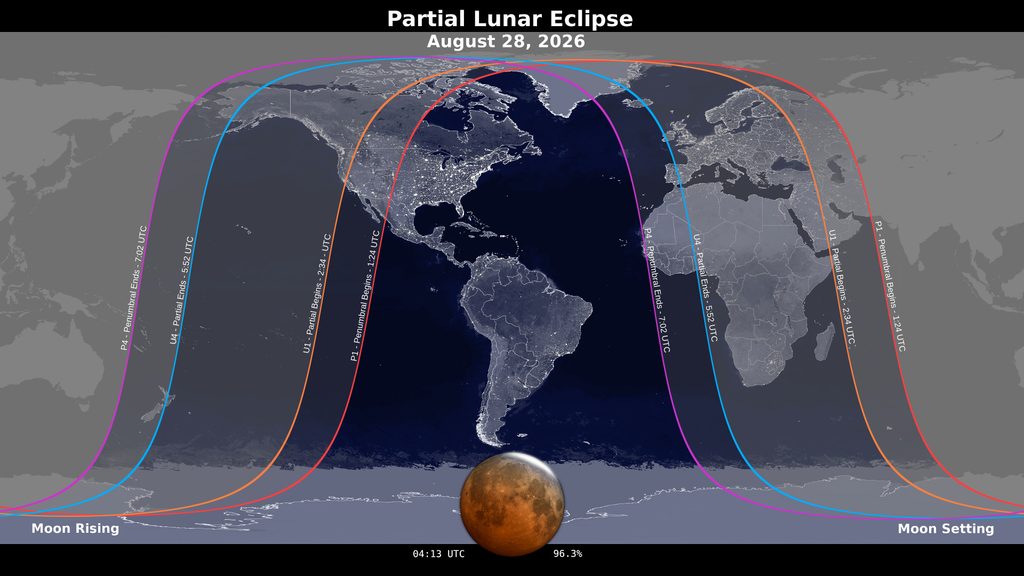
The Moon will already be above the horizon when the eclipse begins for Iowa. Around the 8:23 p.m. start of the penumbral phase in central Iowa, the Moon will still be relatively low in the east-southeastern sky. By the beginning of the partial eclipse at 9:33 p.m., it will be higher in the east-southeast.
At maximum eclipse around 11:12 p.m., the Moon will be approximately 31 degrees above the southeastern horizon in Des Moines. That means you shouldn’t need an exceptionally wide-open horizon during the best portion of the eclipse.
Still, locations away from trees, buildings and bright outdoor lighting will provide a better view.
Do You Need Eclipse Glasses?
No. Unlike a solar eclipse, a lunar eclipse is completely safe to watch with your eyes. You do not need eclipse glasses or any special filters.
You can also safely look at the Moon through binoculars or a telescope. In fact, binoculars can make it easier to see the boundary between the illuminated and eclipsed portions of the Moon and the copper coloration inside Earth’s shadow.
For photography, even modern smartphones may be able to capture the eclipse, although a tripod or other stable surface can significantly improve nighttime images.
How Often Do Lunar Eclipses Happen?
Lunar eclipses aren’t exceptionally rare on a global scale. NASA’s long-term eclipse catalog shows that there are generally two to five lunar eclipses somewhere on Earth during a calendar year.
However, that doesn’t mean Iowa can see all of them. A lunar eclipse can only be observed from the nighttime side of Earth. NASA notes that any individual lunar eclipse is visible from roughly half of the planet.
Some eclipses are also only penumbral, producing a subtle dimming rather than the dramatic dark red Moon associated with a deep partial or total eclipse.
That makes Thursday night’s event particularly noteworthy for Iowa: the entire dramatic partial phase occurs while the Moon is well positioned in the nighttime sky.
When Is the Next Lunar Eclipse Visible in Iowa?
Iowa won’t have to wait very long for another lunar eclipse, although the next one won’t be nearly as dramatic.
A penumbral lunar eclipse occurs February 20, 2027, and part of the event will be visible from Iowa around moonrise. Another penumbral eclipse follows on August 17, 2027.
The next partial lunar eclipse visible from Iowa occurs the night of January 11-12, 2028. It will be a much shallower eclipse, with maximum eclipse occurring around 10:13 p.m. CST in Des Moines.
For those waiting for the next total lunar eclipse visible from Iowa, the wait is considerably longer. The next total lunar eclipse visible from Des Moines is expected on June 26, 2029, followed by another total lunar eclipse on December 20, 2029.
That makes this week’s 96% partial eclipse the closest Iowa will get to a total lunar eclipse for several years.