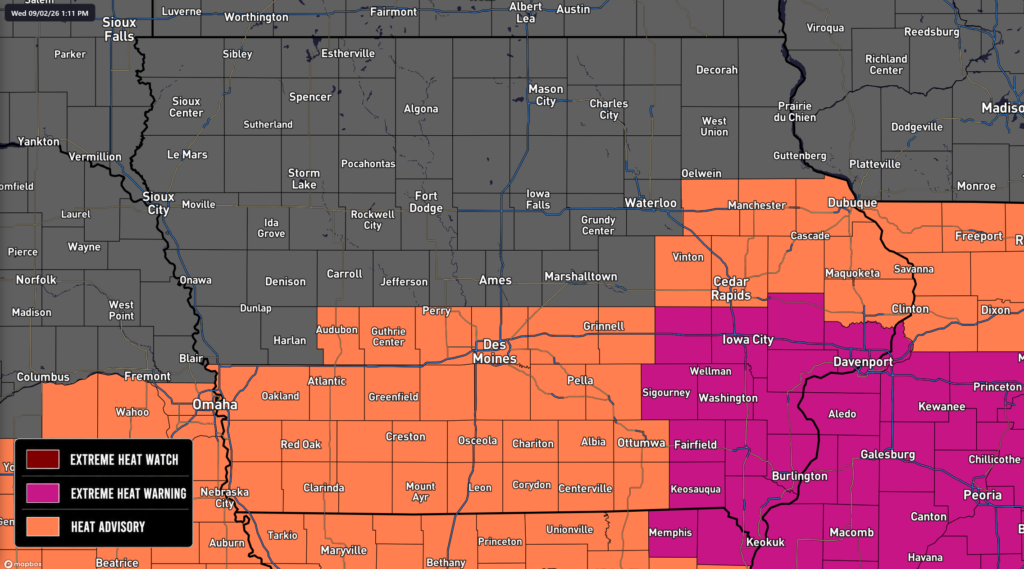
Dangerous heat and humidity will continue across much of Iowa through the end of the workweek, with an Extreme Heat Warning and multiple Heat Advisories in effect as heat index values climb as high as 105 degrees.
The prolonged nature of the heat is also becoming an important concern. Warm overnight temperatures will provide limited relief in some areas, increasing the potential for cumulative heat stress through Friday.
Extreme Heat Warning for Eastern and Southeast Iowa
An Extreme Heat Warning remains in effect until 7 p.m. Friday for portions of eastern and southeast Iowa. The warning includes Iowa City, Davenport, Bettendorf, Muscatine, Burlington, Fort Madison, Washington, Fairfield, Mount Pleasant, Wapello, Sigourney and surrounding communities.
Heat index values could reach around 105 degrees during the hottest portions of the day. The combination of high temperatures and humidity can significantly increase the risk of heat-related illness, especially for people spending extended periods outdoors, those without access to air conditioning and other heat-sensitive individuals.
Heat Advisories Cover Much of Central, Southern and Eastern Iowa
Heat Advisories are in effect across a large portion of central, southern, southwest, east-central and northeast Iowa, with heat index values generally expected to reach 103 to 105 degrees.
The advisory area includes the Des Moines metro, Council Bluffs, Cedar Rapids, Dubuque, Ottumwa, Pella, Oskaloosa, Newton, Grinnell, Indianola, Winterset, Creston, Osceola, Centerville, Atlantic, Audubon, Guthrie Center, Glenwood, Red Oak, Clarinda, Shenandoah, Independence, Manchester, Anamosa, Maquoketa, Clinton and surrounding communities.
Across central and southern Iowa, including Des Moines, heat index values could reach around 103 degrees. Farther southwest, including Council Bluffs and surrounding areas, heat index values could approach 105 degrees.
Most of the Heat Advisory area remains under the alert through 7 p.m. Friday. However, portions of east-central and northeast Iowa, including Cedar Rapids and Dubuque, are currently under a Heat Advisory through 7 p.m. Thursday.
The duration of the heat is an important concern. Even where heat index values do not reach 105 degrees every afternoon, several consecutive days of hot and humid conditions can result in cumulative heat stress.
Overnight temperatures will also remain unusually warm in some areas. Portions of southwest Iowa could see overnight lows only falling into the 73 to 78 degree range, providing little relief from the daytime heat.
Why Several Days of Heat Can Become More Dangerous
The duration of this heat wave is important. Even when temperatures or heat index values do not reach warning criteria every afternoon, several consecutive days of hot weather combined with warm nights can create cumulative heat stress.
Normally, cooler nighttime temperatures give people and buildings an opportunity to recover from daytime heat. When temperatures remain unusually warm overnight, that recovery becomes more difficult.
People without reliable air conditioning, outdoor workers, older adults, young children and anyone participating in strenuous outdoor activities can be particularly vulnerable.
How to Stay Safe During Extreme Heat
Anyone spending time outside over the next several days should take the heat seriously. Drink plenty of water throughout the day and avoid waiting until you feel thirsty to hydrate. When possible, spend time in air-conditioned buildings and limit strenuous outdoor activities during the hottest portion of the afternoon.
If outdoor work or exercise cannot be avoided, schedule frequent breaks in shaded or air-conditioned areas and wear lightweight, loose-fitting clothing. It is also important to check on relatives, neighbors and others who may be vulnerable to extreme heat, particularly those without air conditioning.
Never leave children or pets inside a parked vehicle. Temperatures inside a vehicle can rise to dangerous levels very quickly, even when the windows are partially open.
Know the Signs of Heat Illness
Heat exhaustion can develop after prolonged exposure to high temperatures and may include heavy sweating, weakness, dizziness, headache, nausea or fainting. Someone experiencing symptoms of heat exhaustion should be moved to a cooler location and begin cooling down.
Heat stroke is a medical emergency. Symptoms can include confusion, loss of consciousness or other significant changes in mental state along with dangerously high body temperature. Call 911 immediately if heat stroke is suspected.
Stay with IowaWeather.com and the Iowa Storm Chasing Network for the latest updates as the heat wave continues across Iowa.