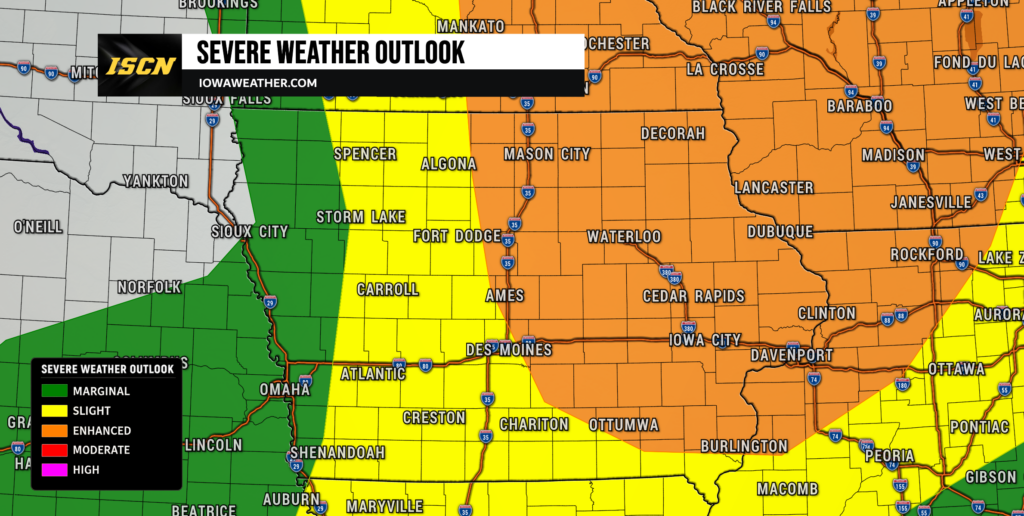
A potentially significant severe weather event is taking shape across portions of Iowa on Wednesday as a strong cold front moves through the state during the afternoon and evening hours. While details will continue to be refined over the next couple of days, confidence is increasing that at least some areas of Iowa will experience severe thunderstorms capable of producing large hail, damaging winds, and tornadoes.
What Is Setting Up?
A powerful upper-level storm system currently developing across the western United States will move into the Upper Midwest on Wednesday. As it approaches, very warm and humid air will surge northward into Iowa ahead of an advancing cold front.
Temperatures are expected to climb into the upper 80s and lower 90s across much of the state, while dew points rise into the upper 60s and lower 70s. This combination will create an extremely unstable atmosphere capable of supporting intense thunderstorm development.
Forecast models indicate instability values could exceed 3,500 to 4,000 J/kg across parts of Iowa Wednesday afternoon, which is more than sufficient to support severe thunderstorms.
Storm Development Expected Wednesday Afternoon and Evening
Thunderstorms are expected to develop along the advancing cold front by early to mid-afternoon across portions of Minnesota, Wisconsin, and northern Iowa before expanding southward across the state through the afternoon and evening.
The Storm Prediction Center notes that scattered to numerous severe thunderstorms are likely across the Upper Mississippi Valley and Midwest, including Iowa. The environment is expected to support organized storm structures such as supercells and bowing segments capable of producing multiple severe weather hazards.
Main Threats
Large to Very Large Hail
Large hail appears to be one of the primary threats during the early stages of storm development. Some storms could produce hail larger than golf balls, especially if discrete supercells are able to develop ahead of the main line of storms.
Damaging Winds
As storms mature and organize into clusters or lines, the threat for damaging straight-line winds will increase. Wind gusts exceeding 60 mph will be possible, with some localized areas potentially seeing stronger wind damage if bowing segments develop.
Tornadoes
The tornado threat will depend heavily on storm mode and timing. Wind profiles will be favorable for rotating storms, especially across eastern Iowa where low-level wind shear is expected to be strongest.
If individual supercells can remain isolated before storms merge into a line, tornadoes could develop. Some stronger tornadoes cannot be completely ruled out if the most favorable ingredients overlap.
Areas of Greatest Concern
At this time, the highest confidence for severe weather exists across northern, central, and eastern Iowa Wednesday afternoon and evening. The Storm Prediction Center specifically highlights eastern Iowa as an area where the risk for damaging winds and tornadoes may be enhanced due to stronger low-level wind shear.
Western Iowa could also see severe storms, though storm evolution and timing may influence the overall threat.
Forecast Uncertainties
One of the biggest questions remains whether thunderstorms Tuesday night or early Wednesday morning will impact the atmosphere ahead of the main event. If widespread clouds and storms persist into Wednesday, instability could be somewhat reduced.
However, if sufficient sunshine develops Wednesday afternoon, the atmosphere could quickly recover and support a more robust severe weather outbreak. The exact timing of the cold front will also play a critical role.
Stay Weather Aware
Now is a good time to review your severe weather safety plans and ensure you have multiple ways to receive warnings. Forecast details will continue to be refined over the next 24 to 48 hours as confidence increases in the timing and location of the greatest threat.
Be sure to have the ISCN Weather app installed and check back with IowaWeather.com and the Iowa Storm Chasing Network over the next couple of days for the latest forecast updates, watches, warnings, and live severe weather coverage.